




Do you need a permit to replace a roof in Nebraska? Not always. Omaha requires a permit for roof work over 200 square feet. Lincoln requires one only when sheathing or rafters are rotted, or when new sheathing is added over the old deck. Rules are set city by city.
Almost every roofing website answers this question with one word: yes. That answer is wrong for thousands of homeowners in Lincoln. So does roof replacement require a permit in Nebraska? It depends entirely on your city and your roof deck.
The 30-Second Version: Permit Rules by City
- Omaha: Permit required for any roof repair or replacement over 2 squares (200 square feet).
- Lincoln: Permit required only for rot damage or new sheathing over existing sheathing.
- Everywhere in Nebraska: Ice barrier, flashing, ventilation, and layer-limit codes still apply.
- Statewide: Nebraska has no roofing license. Contractors register with the Department of Labor.
Two cities, 50 miles apart, give opposite answers. Here is why that happens.

Roofing Permit Lincoln, NE: What Most Contractors Get Wrong
Lincoln and Lancaster County enforce the 2018 International Residential Code and the 2018 International Building Code. Re-roofing must follow IRC Chapter 9, IBC Chapter 15, local amendments, and the manufacturer’s installation instructions.
Here is where the roofing permit rules in Lincoln, NE, split from the national advice you have been reading.
When Lincoln Requires a Building Permit
Under the City of Lincoln Re-Roof Policy, a building permit is required if either condition applies:
- There is rot damage to the roof sheathing, the rafters, or both.
- New 7/16″ plywood or OSB sheathing is installed over the existing roof sheathing.
Read the second one carefully. If gaps between existing boards do not exceed 1/4 inch, new sheathing is not required at all.
In plain terms: Lincoln permits the structural work, not the shingles.
When Lincoln Does Not Require a Permit
Shingling a roof that already has solid sheathing does not require a building permit in Lincoln. That comes with a large asterisk. No permit does not mean no rules.
Every code requirement and manufacturer instruction still applies in full. The only missing piece is a city inspector verifying the work. This makes contractor selection more important in Lincoln, not less. In Omaha, an inspector is your backstop. On a standard Lincoln re-roof, there is no backstop at all.
The Two-Layer Rule Nobody Mentions
If the existing roof has two or more layers of any roof covering, all layers must be removed. No third layer. No exceptions.
This matters on older Lincoln homes in areas like Near South, University Place, and Havelock. A 1970s or 1980s layover was common practice there. If a roofer quotes a cheap shingle-over on a two-layer house, they are quoting non-compliant work.

Omaha Roof Replacement Permit Requirements: The 200-Square-Foot Rule
Omaha is stricter. Its trigger is project size, not structure. Permits are required for all roof repairs and replacements involving more than 2 squares, or 200 square feet.
The city treats anything at or above that threshold as work beyond routine maintenance. Replacing only part of a roof still requires a roof repair permit. Two squares is small. A section measuring 20 feet by 10 feet is exactly two squares. Hail and wind damage on a single slope routinely exceeds that. Many “minor repairs” are legally in permit territory.
What Omaha Requires Beyond the Permit
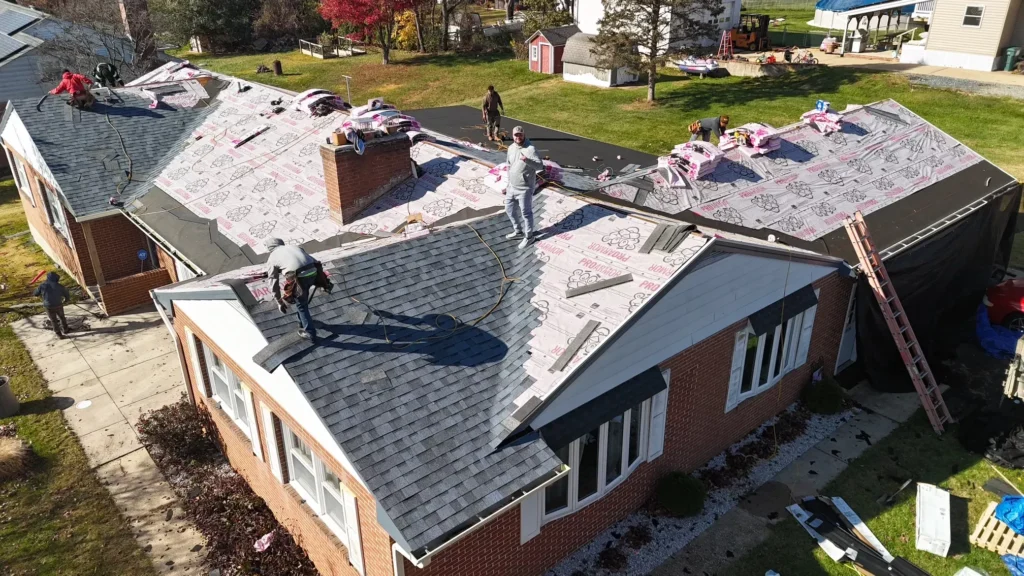
- Full tear-off. Existing roof covering must be removed to the sheathing before the new system goes on. Omaha does not allow layovers.
- Sheathing thickness. 7/16″ is the minimum for new construction. Existing 3/8″ sheathing may stay if it is still performing.
- Failing sheathing. If 3/8″ sheathing shows rot, deterioration, delamination, or excessive deflection, it must be replaced or overlaid with 7/16″.
- Ice barrier over solid sheathing. Areas required to have an ice barrier must be solidly sheathed, even where spaced sheathing is otherwise allowed.
- Drip edge at all eaves and gables. It must extend at least 0.25 inch below the sheathing and at least 2 inches onto the roof, with a 2-inch minimum end lap.
- Final inspection with photos. Photographs of the clean roof deck and installed underlayment must be provided for the inspector’s review.
That photo rule is the one Omaha homeowners should care about most. It proves the deck was documented before shingles covered it. If your contractor is not photographing the bare deck, they are not planning to close the permit.

Why Nebraska Cities Answer This So Differently
Nebraska does not issue a statewide roofing license. It also does not run a statewide roofing permit office. What the state does require is registration. Contractors and subcontractors must register with the Nebraska Department of Labor under the Contractor Registration Act. Registration is not a skills test. The Department states plainly that registration does not ensure quality of work or protect against fraud.
There is also an exemption. Anyone earning less than $5,000 a year from construction services is not a contractor under the Act. So the enforceable rules live at the city level. Our crews follow one checklist in Lincoln, another in Omaha, and another in Council Bluffs.
Smaller communities set their own thresholds. Several route inspections through the county instead. That includes Waverly, Seward, Crete, Gretna, Papillion, La Vista, Bennington, Blair, York, Wahoo, Columbus, Hastings, Grand Island, Fremont, Bellevue, Nebraska City, and Plattsmouth. Never assume the rule from one town applies in the next one over.
Roof Replacement Permit Requirements Nebraska Homeowners Must Meet Anyway
This section protects your home whether or not a permit is pulled. Lincoln’s re-roof policy is specific about what a compliant roof looks like.
Ice Barrier
An ice barrier is required for all spaces. The self-adhering sheet must extend from the lowest edges of all roof surfaces to at least 24 inches inside the exterior wall line.
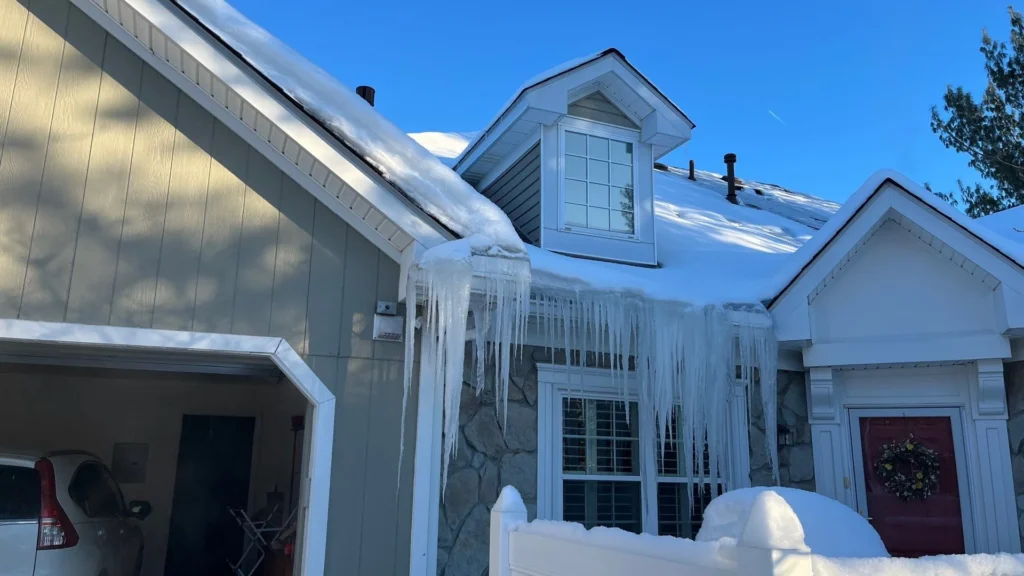
Practical translation: on a home with deep eaves, one 36-inch course is not enough. You need two courses to clear the wall line by 24 inches. This is one of the most commonly shorted items on a low bid. It is also your main defense against ice dams in a Nebraska February.
Flashing
- Valley flashing: minimum 24 inches wide, with a minimum 4-inch end lap where sections join.
- Step flashing: 4″ x 4″, required wherever shingle rows abut a wall on a sloped roof.
- Drip edge: required on all eaves and gables.
- Chimney flashing: a cricket or saddle is required on chimneys 30 inches or wider.
- Replacement rule: flashing that is damaged, rusted or installed incorrectly must be replaced, not reused.
That last line is where cheap bids hide. Reusing old step flashing saves a crew two hours. It costs you a wall leak in three years.
Attic Ventilation
- Upper ventilation only, within 3 feet of the ridge: 1 square foot of ventilation per 150 square feet of attic area.
- Upper and lower ventilation with eave intake: 1 square foot of net free upper ventilation per 300 square feet of attic area.
- Lower or eave ventilation in that same setup: 1 square foot per 300 square feet of attic area.
Undersized attic ventilation cooks shingles from underneath. It shortens roof life and increases ice damming. Ventilation is a code item, not an upsell.
Low-Slope and Flat Roofs
Mineral-rolled roofing is permitted on slopes of 1 inch in 12 inches or greater. Below 1 in 12, a one-piece membrane or liquid-applied covering is required. The minimum slope for any roof is 1/4 inch in 12 for drainage. Where requirements conflict, the most restrictive one governs.
Building Permit for Roof Nebraska: What It Actually Costs
Neither Lincoln nor Omaha charges a flat roof permit fee. Both calculate from project valuation. Valuation means the total value of the construction work, labor, and materials included.
Omaha Permit Fees
Fees follow Table 43-91 in the city code. The minimum fee is $41 for work valued up to $2,000. The building official determines valuation. Your own labor and used materials must still be given a reasonable value.
Permits carry a technology fee. Card payments carry a processing fee that paying by eCheck avoids. For a standard residential re-roof, Omaha needs only the application and the fee. No drawings are required. Applications go through OmahaPermits.com or the Civic Center at 1819 Farnam Street, 11th floor. Inspections are scheduled at 402-444-5350.
Lincoln Permit Fees
Lincoln’s Building and Safety Division sits at 555 South 10th Street. Fees are also calculated from project valuation.
Applications run through the Accela Citizen Access portal. Re-roofs are treated as small projects and can often be handled over the counter.

The Factors That Move Your Number
- Total project valuation is by far the biggest driver.
- Deck replacement raises valuation. In Lincoln, it can turn a no-permit job into a permitted one mid-project.
- Squares and roof complexity, including valleys, dormers, steep pitch, and multiple planes.
- Material type. Synthetic slate, synthetic cedar shake, standing-seam metal, and flat membrane carry higher valuations than architectural asphalt.
- Re-inspection trips. Omaha charges when an inspector must make more than one trip due to contractor-caused issues.
- Structural surprises such as rotted decking or rafters found at tear-off.
The honest takeaway: the permit is rarely the expensive part. The code items behind it are. Ice barrier depth, new flashing, correct ventilation, and decking repair separate a $9,000 bid from a $14,000 bid on the same house. When two quotes are thousands apart, that gap is usually the explanation.
What Happens If You Skip a Required Permit
- Stop-work orders that halt the job mid-tear-off, with your roof open.
- Uncovering work. An inspector can require completed work to be exposed. That means shingles come back off.
- Insurance friction. Unpermitted work gives a carrier grounds to question a later claim. In hail country, that risk is real.
- Warranty gaps. Manufacturer warranties depend on code-compliant, instruction-compliant installation.
- Closing delays. Buyers, agents, and home inspectors ask for permit records. Missing paperwork becomes a price negotiation.
- Personal liability. Whoever pulls the permit is responsible for code compliance. If you pulled it, that is you.
Who Should Pull the Permit, You or Your Contractor?
Your contractor should. Every time. When a registered contractor pulls the permit, their name goes on the inspection record. Responsibility for code compliance sits with them. When a homeowner pulls it, that responsibility transfers to the homeowner. The crew doing the work carries none of it.
If a roofer asks you to pull the permit yourself, treat it as a red flag. The usual reasons are that they are not registered, not insured, or do not want their name on an inspection record.
7-Point Checklist Before You Sign a Roofing Contract
- Written confirmation of whether your address requires a permit, and who is pulling it.
- The contractor’s Nebraska Department of Labor registration.
- Proof of general liability and workers’ compensation coverage.
- Line items for ice barrier, drip edge, valley flashing, step flashing and ventilation.
- Photos of the bare deck and installed underlayment. Required in Omaha, smart everywhere.
- A written per-sheet price for decking replacement if rot is found at tear-off.
- Manufacturer certification backing whatever warranty they are selling you.
If a contractor hesitates on any of these seven, you have your answer.
Why Choose Star Home
Star Home is a locally owned roofing company serving Wahoo, Saunders County, and surrounding communities across eastern Nebraska and Western Iowa. Our team brings over 30 years of combined construction and roofing expertise. We specialize in skylight repair, roof flashing replacement, chimney flashing repair, and full roof services.
What Sets Us Apart
- Locally owned and operated. We live and work in the communities we serve.
- Licensed, bonded, and insured. Every project is completed by qualified professionals.
- Free estimates. No pressure, no hidden fees. You get a transparent, itemized quote.
- Workmanship warranty. We back every repair with a written workmanship guarantee.
- On-the-spot financing. Options available for credit scores as low as 550, no money down.
- 24/7 emergency response. We respond fast when you have an active roof leak.
- Certified by trusted manufacturers. We use premium materials from leading industry suppliers.
Conclusion
The permit question is really a contractor question. A roofer who knows the answer for your specific address and can explain why has read the code. A roofer who says not to worry about it has told you something important. A free inspection tells you three things: the condition of your decking, whether a permit is triggered, and what code requires on your roof specifically.
Stay updated on our services and special offers. Connect with us on Facebook, Instagram, and Google Business Profile.
Contact us today to schedule your inspection or get a free quote.
Frequently Asked Questions
Not always. It depends on your city and the condition of your roof deck. Omaha requires a permit for roof work over 200 square feet. Lincoln requires one only when sheathing or rafters are rotted, or when new sheathing is added over the old deck.
Usually not. Shingling a roof that already has solid sheathing does not require a building permit in Lincoln. A permit is required if there is rot damage to the sheathing or rafters. It is also required if new 7/16″ plywood or OSB is installed over the existing sheathing.
Yes. Omaha requires a permit for all roof repairs and replacements involving more than 2 squares, or 200 square feet. Omaha also requires a full tear-off to the sheathing and a final inspection with photos of the clean deck and underlayment.
There is no flat fee. Both Lincoln and Omaha calculate permit fees based on project valuation, meaning the total value of labor and materials. Omaha’s minimum building permit fee is $41 for work valued up to $2,000, plus a technology fee.
Your contractor should pull it. When a registered contractor pulls the permit, their name goes on the inspection record, and they carry responsibility for code compliance. If a homeowner pulls the permit, that liability transfers to the homeowner.