




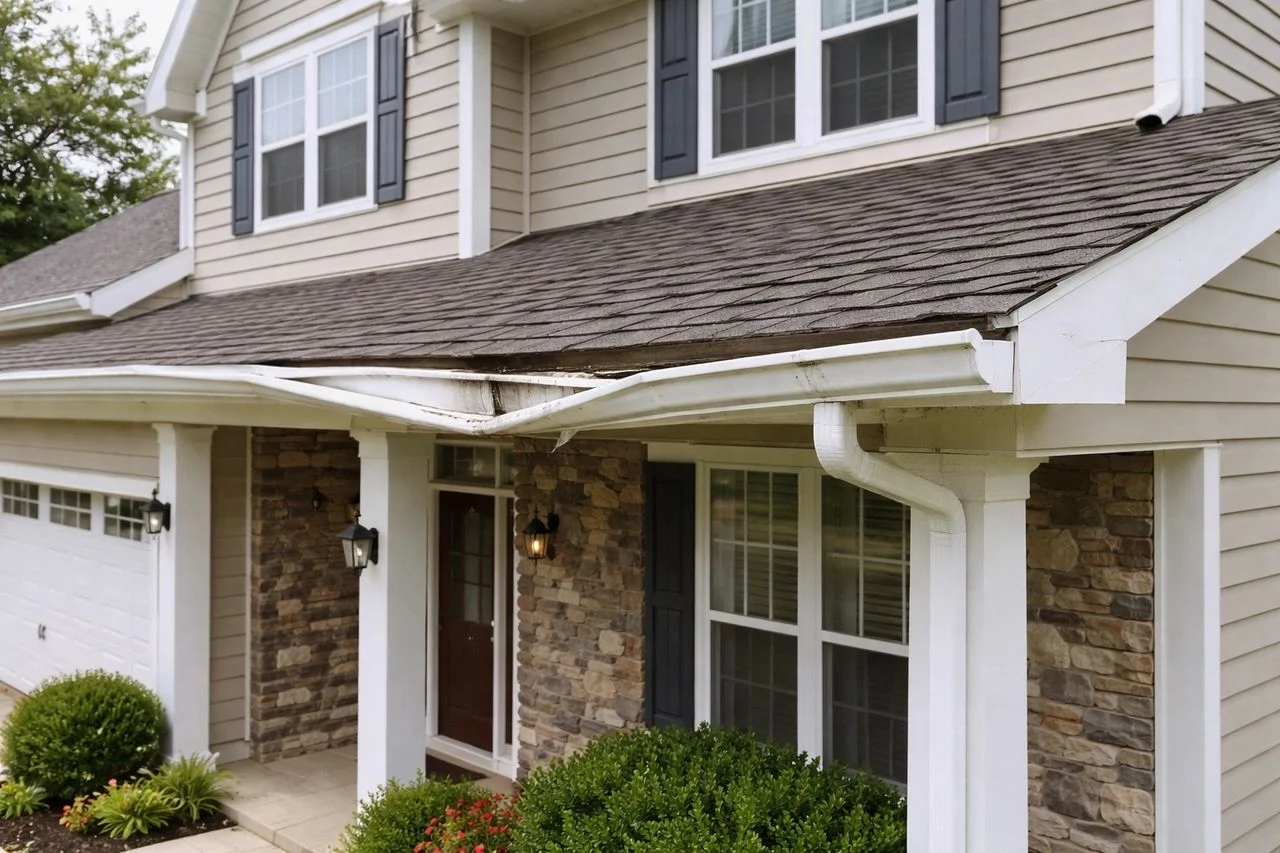
Gutters pulling away from your house in Nebraska usually means the fascia board behind them has rotted. Softened wood cannot hold fasteners under the weight of water and ice. Reattaching the gutter without repairing the fascia only delays the same failure.
You see a gap behind your gutter. One section sags lower than the rest. Most homeowners assume a new nail will fix it. It usually will not. Gutters pulling away from a house in Nebraska almost always signal a deeper failure behind the gutter. This guide explains the real cause, the 2026 cost, and how to tell repair from replacement.
What You Will Learn
- Why this is a fascia problem, not a gutter problem
- The seven root causes, ranked for Nebraska homes
- Warning signs you can spot from the ground
- Why Nebraska winters cause this failure specifically
- What a permanent repair actually involves
- Real 2026 repair and replacement costs
- A clear repair versus replace decision framework
- What happens to your home if you wait
Why Gutters Pull Away From a House
Your gutter is not attached to your home directly. It hangs from fasteners driven into the fascia board. The fascia is the flat trim board along your roofline. Most Lincoln homes use seamless aluminum K-style gutters, hung exactly this way. Everything depends on that board staying dry and solid.
The Weight Your Gutters Actually Carry
A 5-inch aluminum gutter holds roughly 0.38 gallons of water per linear foot. Water weighs 8.34 pounds per gallon. That equals about 3.2 pounds per foot. A 40-foot run carries over 125 pounds during a heavy Lincoln rainstorm.
Now add wet leaves, shingle grit, and the gutter’s own weight. Then freeze all of it in January. Sound fascia handles that load for decades. Softened fascia does not.
This Is a Fascia Problem, Not a Gutter Problem
Use this simple test to tell the difference:
- If the metal is split, crushed, rusted through, or separated at seams, the gutter failed.
- If the metal looks fine but the gutter leans, sags, or gaps, the wood behind it failed.
This is why re-nailing a sagging gutter rarely holds. The nail worked. The wood did not. Anyone searching how to fix a gutter hanging off the house should start the same way. Remove a section and inspect the fascia first.

7 Causes of Gutters Pulling Away From House in Nebraska
1. Spike and Ferrule Fastener Failure
Older homes in Lincoln, Omaha, and Bellevue were commonly hung with spikes and ferrules. A long nail passes through a metal sleeve into the fascia. Aluminum expands and contracts with every temperature swing. Nebraska sees swings of 40 degrees or more in a single winter day.
Over twenty years, the spike walks out fraction by fraction. Eventually the gutter drops. The modern fix is the hidden hanger. It clips inside the gutter and uses a screw instead of a nail.
In snow and ice regions, space hangers every 18 to 24 inches. The 36-inch spacing used in mild climates is not enough here. If you see round metal sleeves along the gutter face, you have spikes and ferrules. That alone explains most sagging gutters in Lincoln, NE.

2. Fascia Board Rot
This is the most expensive cause and the most commonly missed. Water sitting in a clogged or poorly pitched gutter wicks backward into the fascia. The gutter hides the damage until the board is already soft.
Gutters separating from fascia is often the first visible sign. By then, rot has usually been developing for two or three seasons.
3. Ice Dams and Freeze-Thaw Loading
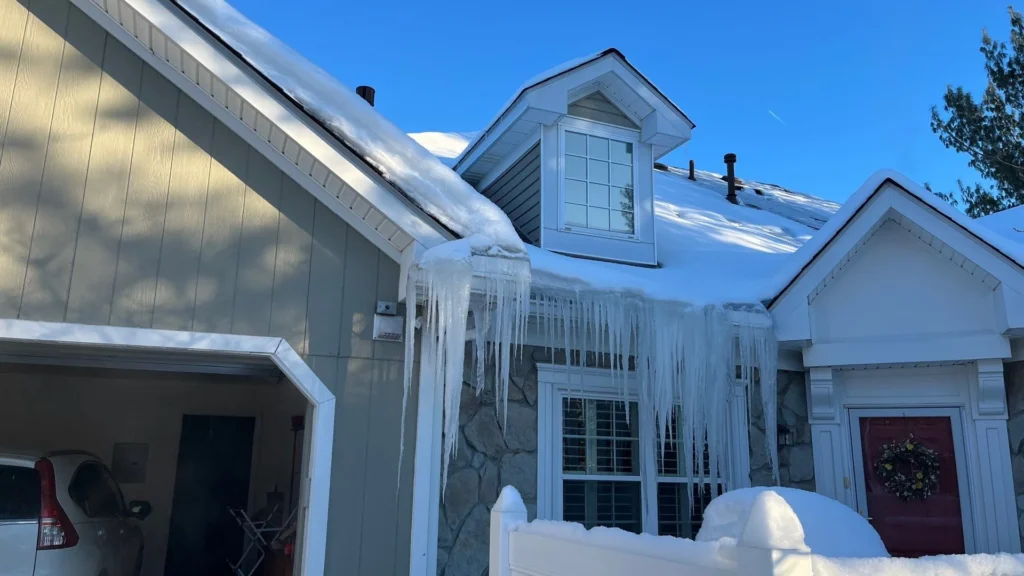
This is the distinctly Nebraska cause. Heat escaping an underinsulated attic melts snow on the upper roof. That water refreezes at the cold eave where no attic sits below. Ice builds inside the gutter and at the roof edge. The gutter now carries a load it was never engineered to hold.
Ice also pushes outward against the gutter’s back wall. That leverage pries it away from the fascia. This is why many homeowners find the problem in February and March. If yours failed over winter, check attic insulation and ventilation too.

4. Clogging and Standing Water
Leaves, pine needles, seed pods, and shingle granules block flow. Standing water is heavy and holds moisture against the fascia constantly.
Homes near mature trees see this fastest. Older Lincoln neighborhoods and the river corridor near Council Bluffs and Sioux City are common examples. Clear your gutters twice a year at minimum. Work it into your fall roof maintenance checklist before the first freeze.
5. Incorrect Pitch
Gutters must slope toward the downspout. The standard is roughly one quarter inch of fall per 10 feet of run.
Too little slope and water sits. Too much and water overshoots the corner. Bad pitch is often an original installation defect. It only shows up after years of standing water.
6. Undersized Gutters or Too Few Downspouts
A 5-inch gutter with a 2×3-inch downspout is the residential default. It is not right for every roof. Large roof planes and valleys can dump concentrated runoff into one section. Nebraska thunderstorms overwhelm undersized systems quickly.
Plan on one downspout for roughly every 30 to 40 feet of run. Long runs with a single downspout usually sag at the far end.
7. Physical and Storm Damage
Hail, straight-line winds, and falling limbs bend or pry gutters loose. Ladders leaned against the gutter lip do the same.
After a Nebraska hail or wind event, gutter and fascia damage may be documentable in an insurance claim. That is worth checking during a storm damage roof repair assessment before paying out of pocket.
Warning Signs You Can Check From the Ground
You do not need a ladder for a first assessment. Walk your property and look for these signs:
- A visible gap between the gutter and the fascia board
- One section hanging lower than the sections beside it
- Nail or spike heads backed out of the gutter face
- Dark staining, peeling paint, or a wavy look on the fascia
- Water streaking down siding instead of exiting the downspout
- Rust or granule streaks on the exterior wall
- Eroded soil or a trench forming below the gutter line
- Standing water against the foundation after rain
- Mold spots or peeling paint near the roofline
- Musty smell, dampness, or white residue in the basement
Three or more of these signs together are meaningful. It means the problem has moved past the gutter into the structure. That is the point to stop watching and book a free roof inspection.
Safety note: Never climb a ladder to inspect a separating gutter. A partially detached gutter is not a handhold and may release under load.
How a Correct Repair Is Actually Done
A permanent fix follows a sequence. Skipping steps is why repairs fail twice.
- Remove the affected gutter section. Hidden fascia cannot be assessed from the ground or from a photo.
- Probe the fascia beyond the visible failure. Sound wood resists a screwdriver. Compromised wood gives. Rot usually extends further than the failure point.
- Check the soffit, drip edge, and decking edge. A failed drip edge lets water run behind the fascia invisibly. Left long enough, this becomes roof decking damage rather than trim work.
- Replace the compromised fascia. Cut back to solid framing. Options include primed pine, cedar, PVC, and fiber cement.
- Rehang on new hardware. Hidden hangers with screws replace spikes and ferrules. Tighten spacing at corners and downspout outlets.
- Reset the pitch and test with water. Re-establish about one quarter inch of fall per 10 feet. Verify flow rather than assuming it.
- Fix the cause, not the symptom. Add a downspout, upsize to 6-inch gutters, or correct attic ventilation. Consider gutter guards if tree debris is the recurring trigger.
Which Fascia Material Is Best for Nebraska?
Nebraska cycles between wet, freezing, and dry conditions. Material choice matters more here than in milder climates.
- Primed pine: lowest cost, requires diligent paint maintenance
- Cedar: better natural rot resistance, moderate cost
- PVC trim: will not rot, strong choice for shaded elevations
- Fiber cement: durable and moisture resistant, pairs well with fiber cement siding
North-facing elevations dry slowly. PVC or fiber cement are worth the upgrade there.
Cost and Factors: 2026 Nebraska Pricing
Cost depends on home height, access, material, and how far damage has spread. These figures follow our published gutter damage repair in Lincoln, NE pricing.
Repair and Replacement Cost Ranges
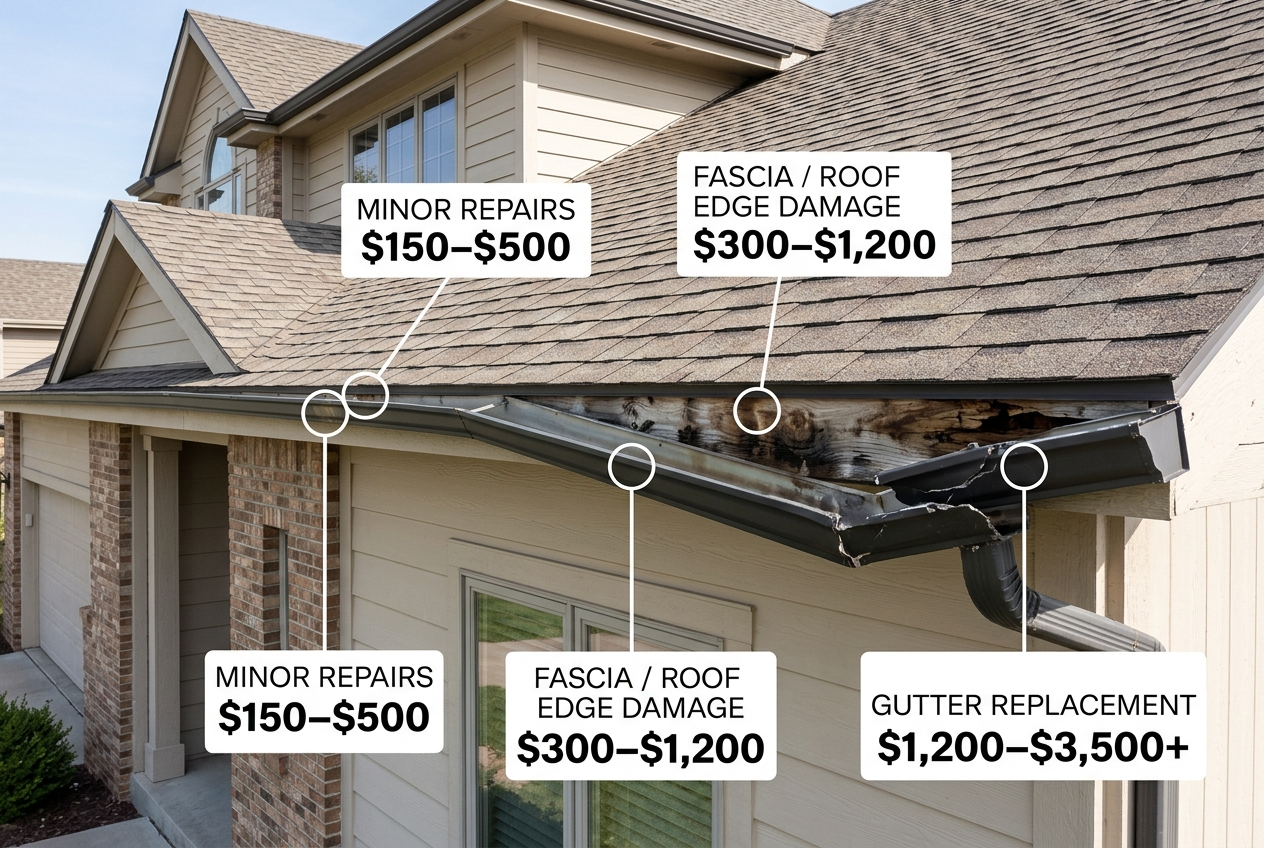
- Gutter leak or seam sealing: $150 to $300
- Reattaching a loose or sagging gutter: $200 to $450
- Downspout repair or reattachment: $150 to $350
- Minor wind-damaged gutter repair: $250 to $500
- Fascia board rot repair: $300 to $900
- Roof edge water damage repair: $400 to $1,200
- Sectional gutter replacement: $500 to $1,500
- Full gutter replacement in Lincoln, NE: $1,200 to $3,500 and up
Fascia rot repair is the most common outcome. That applies when a gutter has been separating for more than one season.
For new systems, see our full gutter installation cost guide for 2026.
What Changes Your Final Number
- Linear footage affected and how many elevations are involved
- Single-story versus two-story access
- Whether soffit or roof decking is also damaged
- Fascia material selected
- Roof pitch and complexity
- Whether you upgrade from 5-inch to 6-inch gutters
- Whether the damage qualifies for an insurance claim
These are planning estimates, not quotes. Accurate pricing requires removing a section and inspecting the wood.
Financing is available in Nebraska for larger replacement jobs.
Gutter Repair vs Replace in Nebraska
Repair is usually right when:
- Only one or two sections are affected
- The system is under roughly 15 years old
- The metal is straight, unrusted, and seams are intact
- Fascia damage is localized
- This is the first failure at that spot
Replacement is usually more economical when:
- Multiple runs are separating on different elevations
- The system is sectional with several leaking joints
- Rust or corrosion holes appear in more than one place
- The same section has been reattached more than twice
- Gutters overflow in every heavy rain
- Repair quotes approach half the cost of a new seamless system
Here is the practical rule. If the fascia is being opened anyway, hanging new gutters at the same time costs far less than a separate job later.
What Happens If You Wait
A separating gutter does not stay a gutter problem. Water is now delivered straight against your home.
The damage escalates in a predictable order:
- Fascia rot spreads along the board and into the soffit
- Soffit failure opens a path into the attic for pests
- Roof decking at the eave softens, turning trim work into roof work
- Siding below the run stains, swells, and loses paint
- Soil erodes and saturates at the foundation
- Basement seepage and foundation movement follow
- Persistent wall moisture creates conditions for mold
None of this happens in a week. All of it happens faster in Nebraska, because freeze-thaw cycling drives water into small openings.
DIY or Call a Professional?
Reasonable DIY tasks:
- Cleaning gutters and downspouts twice a year
- Flushing a clogged downspout
- Extending downspout discharge away from the foundation
- Trimming overhanging branches
Call a professional when:
- The gutter is already separated, sagging, or hanging
- The fascia looks stained, soft, or wavy
- The work is above single-story height
- The same section has failed before
- Damage followed a hail or wind event
- You cannot tell whether the wood behind the gutter is sound
The reattachment itself is not the hard part. Diagnosing what sits behind the gutter is.
Nebraska Gutter Maintenance Calendar
Spring, March to May
Clear winter debris. Inspect for ice damage, separated sections, and backed-out fasteners.
Summer, June to August
Watch behavior during heavy thunderstorms. Overflow or overshooting corners signal clogs, pitch problems, or undersizing.
Fall, September to November
The most important cleaning of the year. Clear everything before the first hard freeze.
Homes under heavy tree cover should consider leaf gutter guard installation.
Winter, December to February
Watch for icicles and ice dams at the eave. Repeated ice dams point to an attic insulation problem.
Why Choose Star Home
Star Home is a locally owned roofing company serving Wahoo, Saunders County, and surrounding communities across eastern Nebraska and Western Iowa. Our team brings over 30 years of combined construction and roofing expertise. We specialize in skylight repair, roof flashing replacement, chimney flashing repair, and full roof services.
What Sets Us Apart
- Locally owned and operated. We live and work in the communities we serve.
- Licensed, bonded, and insured. Every project is completed by qualified professionals.
- Free estimates. No pressure, no hidden fees. You get a transparent, itemized quote.
- Workmanship warranty. We back every repair with a written workmanship guarantee.
- On-the-spot financing. Options available for credit scores as low as 550, no money down.
- 24/7 emergency response. We respond fast when you have an active roof leak.
- Certified by trusted manufacturers. We use premium materials from leading industry suppliers.
Conclusion
A separating gutter is information. It tells you something behind it has been wet for a long time. Caught early, this is a modest repair. Left alone, it becomes fascia rot, then soffit damage, then foundation work.
If you see a gap, a sag, or streaking on your siding, find out what the wood looks like. That answer costs nothing.
Stay updated on our services and special offers. Connect with us on Facebook, Instagram, and Google Business Profile.
Contact us today to schedule your inspection or get a free quote.
Frequently Asked Questions
The fascia board behind them has usually rotted and can no longer hold fasteners. Old spike-and-ferrule hardware backing out over time is the other common cause.
You can, but it will likely fail again. If the fascia is rotted, the fastener has nothing solid to grip.
From the ground, look for dark staining, peeling paint, or a wavy surface on the fascia. Confirmation requires probing the wood during an inspection.
Usually not, but a gutter hanging off the house is a falling hazard. It should be secured or removed promptly.
Reattaching a section to sound fascia runs $200 to $450. If the fascia has rotted, expect $300 to $900, and more if soffit or decking is involved.